

“Fast payout” is the most repeated phrase in pokies reviews, and the least defined. A review that says an operator pays out quickly without stating the payment method, the verification status, and the counting convention has repeated marketing copy. This desk does not rate operators. It teaches readers how to read the numbers other sites publish. A tested withdrawal claim must contain specific conditions, a vague claim omits them, and payout-speed evidence should be weighted carefully before it influences any score. If you are comparing review scores, start by checking whether the speed claim names a payment method, a verification status, and a day-counting convention.
Why “Fast” Is the Least Specific Word in a Pokies Review
The phrase appears everywhere. Operators advertise it, review sites repeat it, and players search for it. Yet “fast withdrawal” carries no inherent meaning without a defined testing method behind it. A claim of fast payouts could describe anything from a same-day e-wallet transfer to a five-business-day bank clearance, and both could technically be called “fast” depending on the baseline.
The problem is structural. Marketing language is designed to flatter, and precision is not the goal. When a review site lifts the operator’s own “24-48 hours” phrasing and presents it as a finding, the reader cannot distinguish between a measured result and a restated promise. This desk’s editorial policy is clear on that point: it does not publish invented payout percentages or ratings dressed up as data it does not have. The same standard should apply to any review that claims to have tested withdrawal speed.
A tested claim names its conditions. A repeated claim names nothing. That distinction is the entire basis for evaluating whether a payout-speed statement deserves to move a score.
The Three Variables That Make “Fast” Meaningless Without Them
Withdrawal processing time depends on at least three variables, and omitting any one of them makes the claim unverifiable.
Payment method. E-wallets, cards, and bank transfers move money through different rails. Each has its own settlement steps, and the elapsed time from request to funds received will differ accordingly. A review that says “withdrawals are fast” without naming the method tested has not provided enough information to reproduce the result.
KYC and verification status. Know Your Customer verification is a standard regulatory requirement before a withdrawal can be released. If the account was already verified at the time of the request, the clock starts differently than if the reviewer had to submit documents mid-process. Comparing a verified account’s withdrawal time to an unverified account’s withdrawal time is comparing two different things.
Business days versus calendar days. A stated window of “three days” could mean three business days, which can stretch across a weekend into five or more calendar days. Reviews that do not specify which convention they used leave the reader guessing. The difference matters most for claims made on a Friday afternoon, when a same-day processing window can become a Monday delivery.
A vague claim omits all three. A tested claim states all three up front.
E-Wallet Withdrawal Claims: The Fastest Category, but Still Needs a Window
E-wallet withdrawals are typically processed faster than card or bank-transfer withdrawals in the payments industry generally. The reason is structural. E-wallet transfers skip the card-network settlement steps that add time to other methods. That does not mean every e-wallet claim is automatically trustworthy.
A review that tested an e-wallet withdrawal should still state the processing window it observed and note any provider-side hold. A review should also check whether the e-wallet provider itself applies any holding period before funds are accessible, separate from the casino’s own processing time. A claim that says “paid out in two hours” and skips the provider-side hold tells only part of the story.
Faster payment rails produce faster withdrawals. The review should still name the rail, the observed window, and any additional delay introduced outside the operator’s control. Without those details, the claim stays an untested expectation.

Card and Bank-Transfer Claims: “Up to X Days” Is Not a Tested Figure
Card and bank-transfer withdrawals commonly involve additional settlement and clearing steps compared to e-wallets. Operator terms often state ranges like “up to X business days.” That figure is a stated ceiling, never a measured result.
When a review repeats “up to five business days” from the operator’s terms and conditions, it has quoted a contractual maximum. The actual elapsed time could be shorter. The review has no evidence of that, because no withdrawal was requested and logged.
A tested claim for a card or bank transfer would state the actual time from request to funds received, the payment method used, and the verification status at the time of request. It would also acknowledge that bank processing times can vary based on factors outside the operator’s control, such as the player’s own bank. A review that cannot provide those details should mark the claim as unverified. Presenting it as a finding would be a mistake.
Where KYC Verification Sits in the Withdrawal Timeline
KYC completion status affects how long a withdrawal actually takes from request to funds received, and the timing depends on where in the process it sits. A review that measures “time since request” without noting whether the account was already verified is measuring a variable that depends on an unstated precondition.
Consider two hypothetical withdrawals from the same operator. One account was verified weeks ago; the other submitted documents at the same time as the withdrawal request. The first might clear in hours. The second might take days while documents are reviewed. A review that reports only the elapsed time for each would produce two different numbers for the same operator, and neither number would be meaningful without the verification context.
A tested claim should state whether the account was verified before the withdrawal request or whether verification happened as part of the process. That single detail determines whether the measured time reflects the operator’s payout speed or the combined time of verification plus payout.
Tested Claims vs Repeated Claims: How to Tell the Difference
A withdrawal-speed claim is tested when a reviewer requests a real withdrawal and logs the actual elapsed time and payment method. It is repeated when a review restates the operator’s own marketing or terms-and-conditions language without independent verification.
A tested claim names a specific payment method, a verification status, and a measured window. A repeated claim uses the operator’s own marketing wording straight from its terms and conditions, without any indication that a withdrawal was actually requested and timed.
Picture a hypothetical test. A reviewer requests a withdrawal of AU$200 on a Tuesday at 10:00 AM using a PayPal-style e-wallet service. The account has been fully KYC-verified for three weeks, so no document submission is required at the point of request. The reviewer notes the day-counting convention as business days. The operator confirms processing and releases the funds to the e-wallet provider on Wednesday at 2:00 PM, and the reviewer records the funds as accessible in the e-wallet balance at that same time. The logged elapsed time is one business day, or approximately 28 hours from request to accessible funds. That entry, with its payment method, verification status, and day-counting convention all stated, constitutes tested evidence. A second hypothetical withdrawal using a bank transfer from the same operator might take four business days to appear in the player’s bank account, and that figure would be logged separately with its own method and verification context. Neither figure is presented as a universal operator speed; each is a single observation tied to specific conditions.
This desk’s editorial policy matches that standard. Lyft Grocery does not publish invented payout percentages or ratings dressed up as data it does not have. When a review site claims to have verified a payout speed, the reader should be able to find the method behind that claim. If the method is absent, the claim is marketing.
How This Desk Weights Payout Speed in a Score
Payout-speed evidence carries significant weight in review scoring because it reflects whether an operator does what it promises. In this desk’s stated five-part weighting, payout-speed evidence accounts for 25% of the total score. Only licensing and fairness evidence, at 30%, carries more weight. Game-variety depth follows at 20%, support responsiveness at 15%, and terms clarity at 10%.
The weighting reflects a simple principle. An operator that pays out slowly or unpredictably fails at the most basic function of a casino account. Licensing confirms the operator is legitimate; payout speed confirms it behaves legitimately in practice. The how we build a score page sets out the full method behind this weighting.
That 25% weighting applies only to tested evidence. A review that repeats the operator’s own “fast withdrawal” language without verification should not receive the same score as one that logged a real withdrawal. The score should reflect the evidence, not the marketing.
Payout-speed evidence also looks different at different tiers of the scoring scale. At the top tier, a well-documented test includes a logged withdrawal request with the payment method named, the verification status confirmed as already complete, the day-counting convention specified, and the elapsed time recorded from request to accessible funds. That kind of evidence supports a high payout-speed score because it is reproducible and verifiable. At the middle tier, partial documentation might include a stated processing window from the operator’s terms, or a single logged withdrawal without full verification details, leaving the reader to infer whether the account was pre-verified. That evidence supports a moderate score at best, since the missing variables could materially change the result. At the bottom tier, no evidence exists beyond the operator’s own marketing language, and a review that repeats such language without any logged test should not receive meaningful payout-speed credit at all. The scoring distinction between these tiers is what separates a measured claim from a restated promise.
Responsible Gambling: Withdrawal Speed Is Not a Reason to Chase Losses
Withdrawal speed is a convenience feature. A casino account behaves nothing like a savings account. The speed at which an operator processes withdrawals should never be the reason a player deposits money they cannot afford to lose. Fast payouts do not reduce gambling harm, and they should not be treated as a reason to gamble more.
If gambling stops being a form of entertainment and starts feeling like a problem, help is available. BetStop is Australia’s National Self-Exclusion Register for online gambling and wagering. It allows individuals to exclude themselves from licensed Australian gambling services. More information is available at the BetStop official site. All gambling content on this desk is intended for readers 18 years and over.

Checklist: What a Tested Claim States vs What a Vague Claim Omits
A tested claim and a repeated claim diverge on four specific points. All rows below are methodological illustrations, none referencing any specific operator.
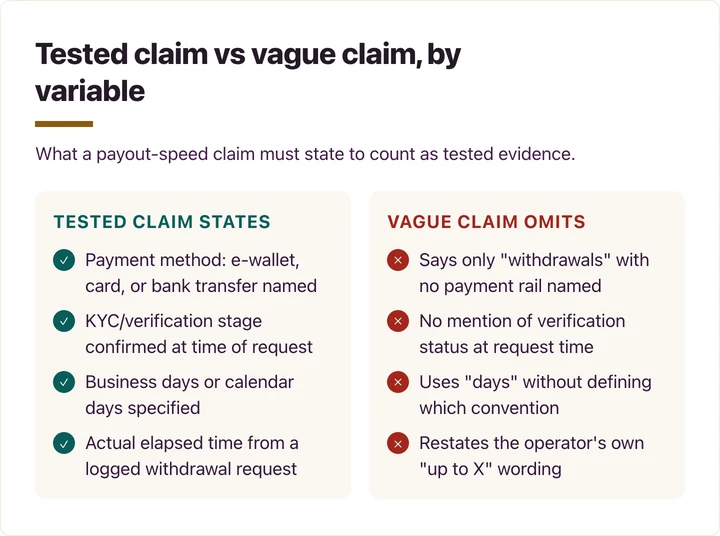
| Variable | What a tested claim states | What a vague claim omits |
| Payment method | Names the specific method used (e-wallet, card, bank transfer) | Says only “withdrawals” without specifying the payment rail |
| KYC/verification stage | States whether the account was verified before the request | Does not mention verification status at the time of request |
| Day-counting convention | Specifies business days or calendar days | Uses “days” without defining which kind |
| Measurement basis | Reports actual elapsed time from a logged withdrawal request | Restates a stated processing window from the operator’s terms, such as “up to five business days” |
FAQ
Does a faster payout mean a better operator?
Not automatically. Payout speed is one factor among several, including licensing, game variety, support responsiveness, and terms clarity. A fast payout from an unlicensed operator is a poor trade-off. The score should weigh tested payout evidence alongside licensing and fairness evidence, and speed should never be treated as the only measure of quality.
Why do e-wallets usually pay out faster?
E-wallet withdrawals typically process faster than card or bank transfers because they skip card-network settlement steps. That structural difference means the payment method itself influences the elapsed time, which is why a review must name the method used before its speed claim means anything.
What is KYC and why does it delay withdrawals?
KYC stands for Know Your Customer. It is a standard regulatory requirement that operators verify a player’s identity before releasing a withdrawal. If the account is not already verified when the withdrawal is requested, the verification process adds time to the overall wait. A review that does not state the verification status at the time of request is measuring an incomplete picture.
Is “24-48 hours” in the terms a guarantee?
No. Terms-and-conditions language like that quoted range is a stated processing window, not a measured result. It may also count business days, an assumption that extends the actual wait beyond what a reader expecting calendar days would count. A review that repeats this language without logging a real withdrawal has not tested the claim.
Where can I check if I need help with gambling in Australia?
The BetStop official website has full registration details. All readers should be 18 or over to engage with gambling content.
How should I interpret a review score that mentions fast payouts?
Check whether the review states the payment method, the verification status, and the day-counting convention behind its claim. If those details are missing, the score may simply reflect repeated marketing language, with no tested evidence behind it. Our guide to interpreting casino review scores and ratings covers this in more depth.